Publications, 2026
Application of Mixed Reality in Endoscopic Streaming During Skull Base Surgery
Operative Neurosurgery, Apr 2026. An earlier version appeared as a meeting abstract in the Journal of Neurological Surgery Part B: Skull Base 87(S 01):S138.
Clinical Publisher doi:10.1227/ons.0000000000002029 BibTeX
Abstract
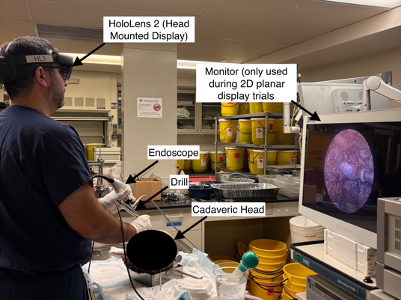
BACKGROUND AND OBJECTIVES: Despite the success of the endoscopic endonasal approach, ergonomic and workflow challenges require surgeons to operate outside their direct line of sight using nonsterile 2-dimensional (2D) planar displays. Mixed reality (MR) may address these limitations by unifying video feeds and imaging into a heads-up display; however, its role during intraoperative streaming remains unclear. The objective of this study was to evaluate the performance, usability, and ergonomics of MR compared with 2D planar displays during endoscopic skull base surgeries in cadaveric models. METHODS: Four skull base neurosurgeons from a single institution each conducted 4 cadaveric trials of endonasal endoscopic skull base dissections, 2 with a 2D planar display and 2 with an MR-streaming interface (HoloLens 2). Surgical performance was evaluated through (1) an objective error analysis performed by a neurosurgeon blinded to the display type and (2) a blinded video condition recognition survey distributed to skull base surgery experts and nonexperts. MR-streaming interface usability and ergonomics were evaluated through post-trial Surgical Task Load Index scores and Simulator Sickness Questionnaire, respectively. RESULTS: An objective error analysis revealed that the total number of errors encountered between MR-streaming and 2D planar display conditions was comparable within the limits of this sample (P = .73). Subgroup analysis per error type further demonstrated no significant differences for all examined errors. Survey responses showed no significant difference in the experts' and nonexperts' abilities to distinguish between MR-streaming and 2D planar display conditions (P = .90). MR-streaming was associated with reduced task load compared with current literature. Finally, MR-streaming had ergonomic shortcomings such as general discomfort, eyestrain, and difficulty concentrating. CONCLUSION: MR-streaming provides comparable surgical task performance compared with 2D planar displays during cadaveric endoscopic skull base surgeries. With further user experience and latency improvements, this novel method provides a promising pathway toward a digital operating room environment.
Citations
Cited by 1 work.
BibTeX
@article{choi2026application,
  title={Application of Mixed Reality in Endoscopic Streaming During Skull Base Surgery},
  author={Choi, Yujin and Bhatia, Shovan and Monek, Adam C. and Alexander, Harrison and Khan, Talha and Szczepkowski, Brendan and Hurt, Griffin and Tang, Anthony and Kann, Michael R. and Shanahan, Regan M. and Gjesdal, Brock and Basdeo, Rishi and Affolter, Kyle and Fernandes Cabral, David and Zenonos, Georgios A. and Gardner, Paul A. and Biehl, Jacob T. and Andrews, Edward G.},
  journal={Operative Neurosurgery},
  year={2026},
  month=apr,
  publisher={Ovid Technologies (Wolters Kluwer Health)},
  doi={10.1227/ons.0000000000002029},
  note={An earlier version appeared as a meeting abstract in the Journal of Neurological Surgery Part B: Skull Base 87(S 01):S138.},
}