Publications, 2025
Optimizing the Workflow of Superficial Temporal Artery Mapping in Extracranial-Intracranial Bypass Surgery Using Mixed Reality: A Proof-of-Concept Study
World Neurosurgery, Dec 2025
Clinical PDF Publisher doi:10.1016/j.wneu.2025.124562 BibTeX
Abstract
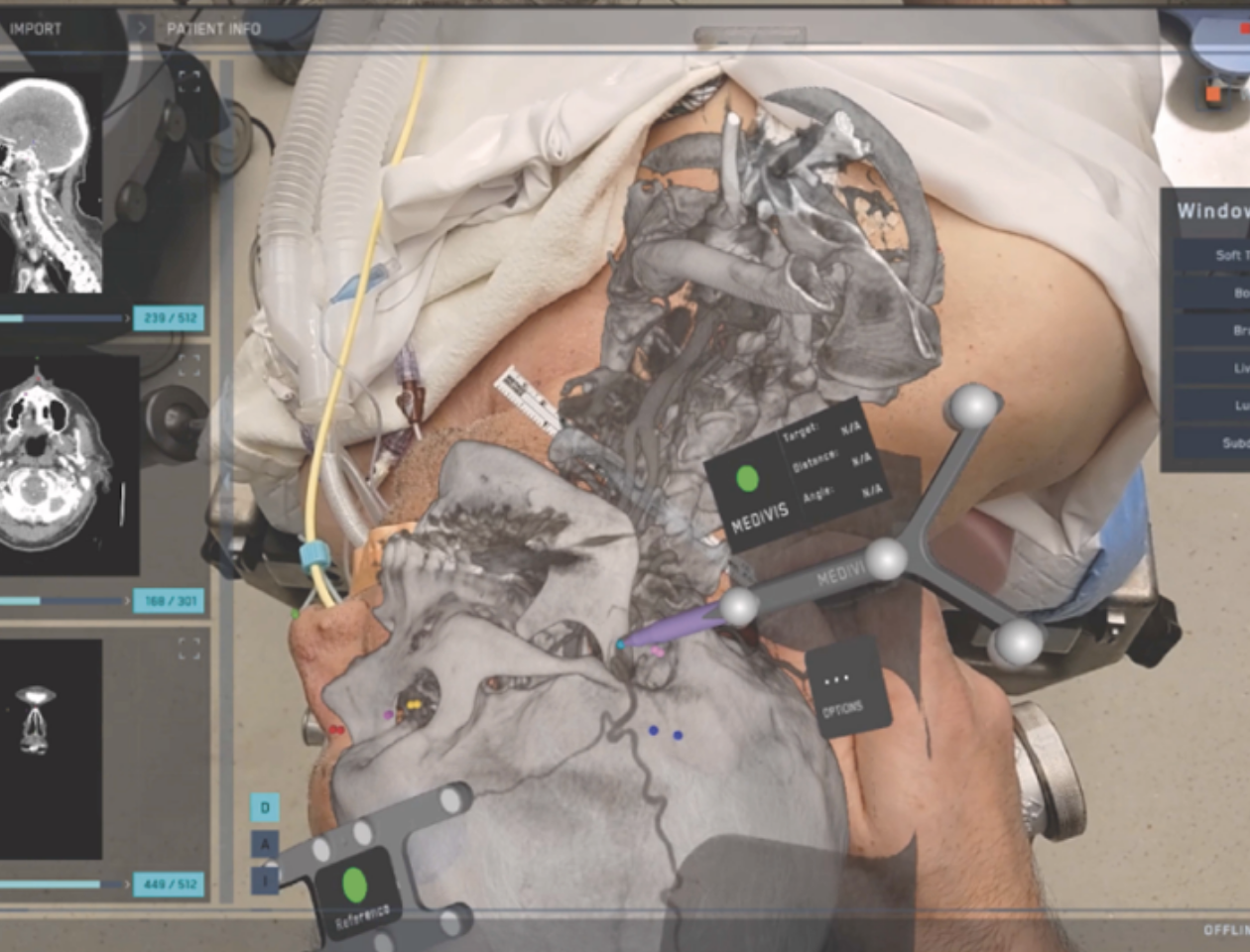
Background: Doppler ultrasound is the standard for mapping the superficial temporal artery (STA) during extracranial-intracranial (EC-IC) bypass surgery. Mixed reality (MR) offers a novel alternative by providing patient-specific anatomic overlays to better visualize the STA. This study aims to validate MR-guided STA mapping as a reliable preoperative planning tool in EC-IC bypass to the middle cerebral artery. Methods: In this proof-of-concept study, 7 patients undergoing STA–middle cerebral artery bypass surgery were enrolled. Preoperative computed tomography angiograms were superimposed onto the patient using MEDIVIS SurgicalAR. Six standardized anatomic fiducial points were chosen for intraoperative registration. Five points along the parietal branch of the STA were annotated using MR and Doppler techniques. Point-to-point discrepancies between the MR and Doppler maps were analyzed, and map overlap was evaluated with computer vision techniques (OpenCV, Python). Significance was set at P < 0.05. Results: MR mapping of the STA was faster than Doppler mapping (11.3 ± 1.47 vs. 67.2 ± 17.6 seconds; P = 0.001). When considering the time to register, the overall time for MR mapping was similar to Doppler (79.2 ± 39.8 vs. 67.2 ± 17.6 seconds; P = 0.78). Notably, MR outperformed Doppler at the distal segments of the STA (2.71 ± 0.91 vs. 20.90 ± 8.46 seconds; P < 0.001). Overall, the MR and Doppler maps demonstrated comparable alignment, with an average deviation of 4.46 ± 2.64 mm along the entire course of the mapped vessel. Conclusions: MR provides comparable STA mapping accuracy to Doppler while reducing the mapping time. These findings suggest that the planned incision is unlikely to differ, providing early evidence for the feasibility of MR-guided mapping for EC-IC bypass procedures.
Citations
Cited by 1 work.
BibTeX
@article{BHATIA2025124562,
title = {Optimizing the Workflow of Superficial Temporal Artery Mapping in Extracranial-Intracranial Bypass Surgery Using Mixed Reality: A Proof-of-Concept Study},
journal = {World Neurosurgery},
volume = {204},
pages = {124562},
year = {2025},
issn = {1878-8750},
doi = {https://doi.org/10.1016/j.wneu.2025.124562},
url = {https://www.sciencedirect.com/science/article/pii/S1878875025009209},
month=dec,
author = {Shovan Bhatia and Aaron Huynh and Regan M. Shanahan and Michael R. Kann and Adway Gopakumar and Nikhil Sharma and Nicolás M. Kass and Griffin Hurt and Rishi Basdeo and Nicole Don and Michael J. Lang and Jacob T. Biehl and Edward G. Andrews},
keywords = {Bypass surgery, Cerebrovascular neurosurgery, Mixed reality, Operative workflow},
}