Publications, 2024
Untethered Displays: The Effects of Mixed Reality on Split-Attention in Fine-Motor Tasks
BPhil thesis, University of Pittsburgh, Apr 2024
HCI PDF Repository BibTeX
Abstract
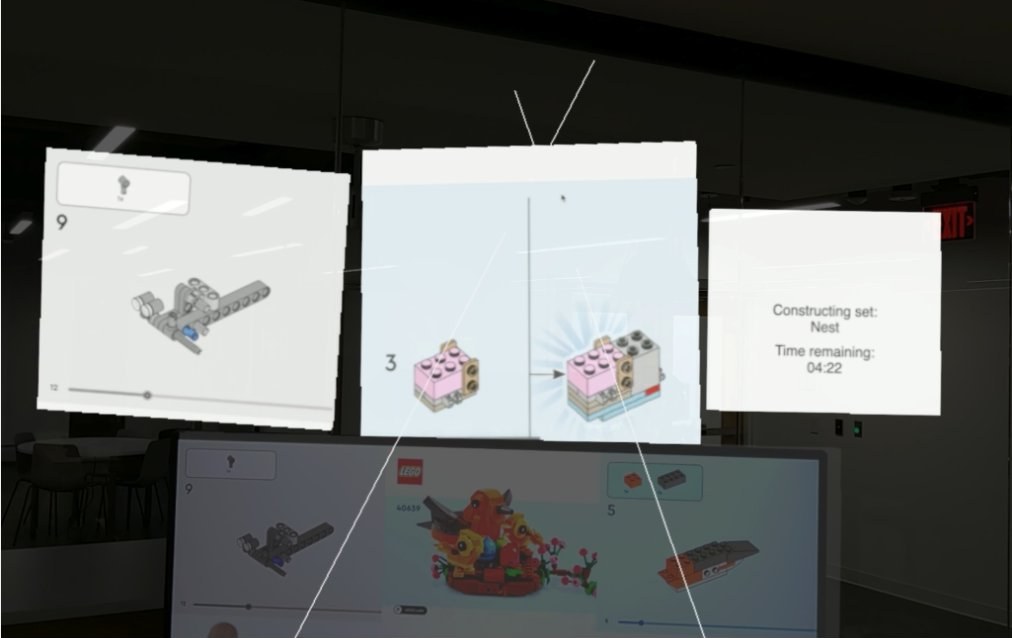
Augmented reality presents new affordances for users to interact with information without limitations of the physical world. For instance, a surgeon in the operating room may want to adjust a monitor without breaking the sterile field, or a military technician may need to reference information from an immovable screen. These environments currently use either large displays or personal tablet devices to present this information to the user. We have developed a system allowing users to segment a physical display, virtualize the segments as holograms in mixed reality, and position the elements around the task space. We also conducted a user study to understand the effects of display modality (mixed reality, tablet, or large display) on participant performance and preferences. We chose Lego construction as our experimental task, as it is reinforced by the literature and mirrors the critical interaction challenges that exist in constrained environments. We found no significant difference in performance between the three modalities, indicating mixed reality may provide a drop-in solution to places where displays or tablets are disadvantaged. The tablet modality was subject to familiarity bias, which may have affected participant rankings. Participants were likely to recommend mixed reality for hypothetical people completing tasks with more restrictions than the experimental task, regardless of their personal ranking order. Overall, these findings present design implications for replacing large displays and personal tablets with mixed reality in information-rich environments.
BibTeX
@thesis{hurt2024untethered,
  title={Untethered Displays: The Effects of Mixed Reality on Split-Attention in Fine-Motor Tasks},
  author={Hurt, Griffin J.},
  type={Bachelor of Philosophy thesis},
  school={University of Pittsburgh},
  year={2024},
  month=apr,
}